Description
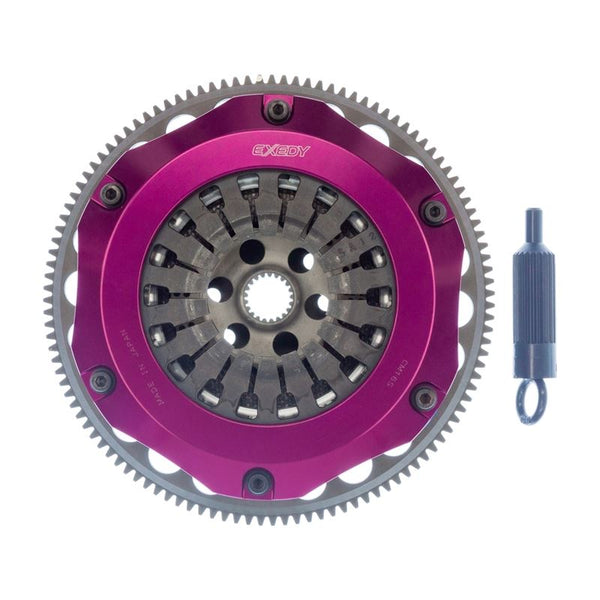
The flagship model of EXEDY clutches, the Hyper Carbon Series. In 1995 EXEDY supplied carbon clutch products for use in the pinnacle series of motorsport; Formula One. This same technology is now applied to carbon clutches developed by EXEDY for use on the street and track. These clutches are lightweight, durable and resilient to high heat, contributing to an improvement in track times. Available in single, twin and triple designs with both rigid or damper discs for a full range of power holding capacity. EXEDY carbon discs are able to perform through long durations of high rotational velocity due to our precise application of carbon. The fibers are set one-by-one in a weaving pattern and baked at more than 3600 Deg. F, finalizing the strengthening process. Heat expansion rate is 1/20th of iron therefore eliminating a change in clutch feel that may happen due to distortion caused by expansion during driving. Carbon material also possesses a “non-stick” characteristic that eliminates disengagement problems. The next generation of clutch systems by EXEDY is the Hyper Carbon-D, the revolutionary carbon clutch system. Carbon-D was developed to achieve the ultimate goal of comfort and streetability by absorbing noise and vibration emitted from drivetrain components such as the differential, transmission and engine. The Carbon-D system is designed to protect the drivetrain by absorbing and dissipating “shock torque” by utilizing EXEDY Patented Technology. Superior engineering enables the Carbon-D clutch system to posses an ideal clutch engagement position, increased clamp loads and lower pedal effort, while the unique carbon fiber friction material allows comfortable half-engaged clutch operation and responsive gear changes. The EXEDY Hyper Carbon-D is available in both single and twin clutch configurations.
Features:
- Average of 40% increase in clamp load over stock
- Extra capacity handles street/race car power upgrades
- Forged assembly is far stiffer than stamped-type
- Incredible strength means no clamp-load deflection
- Integrated turbine-like fins enhance airflow, keeping clutch assembly cooler and extending component life
- Ductile iron pressure plate provides high strength, anti-burst protection in all temperature ranges
- Forged Chromoly Flywheel
- Combination of low weight and high heat capacity
- Designed for Rally, Drag and hi-performance Street
- Reduced weight and inertia means snappier throttle response and quicker shifting
- Designed to increase airflow to help cooling
- One-piece flywheel – starter teeth machined in place
- Unlike aluminum flywheel, ring gear cannot separate
- SFI approved for racing
Includes:
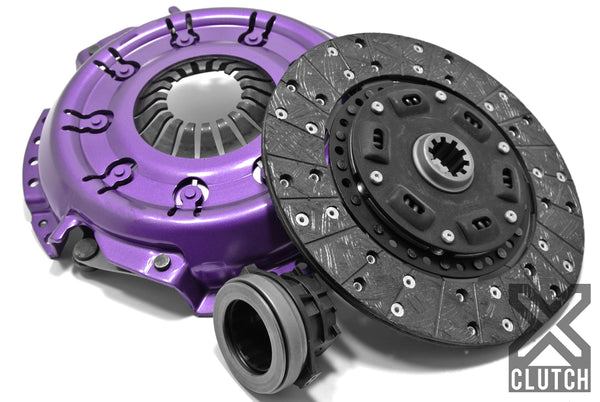
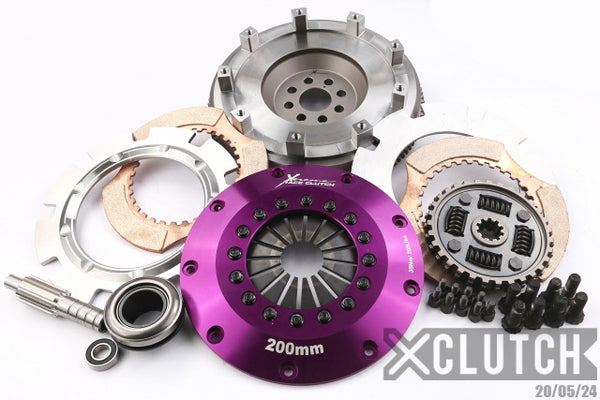
- Clutch Cover Assembly
- CD Assembly
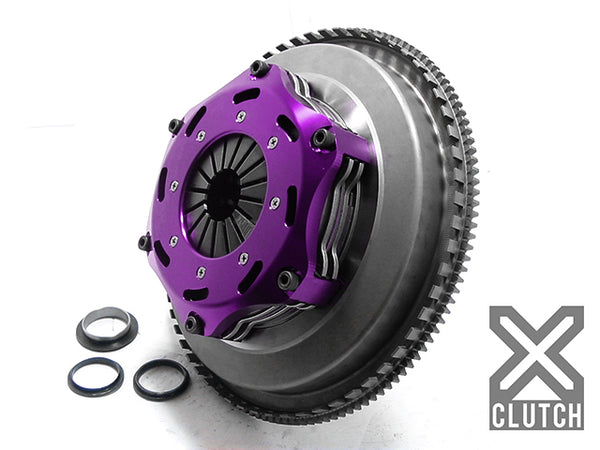
- Flywheel
- Cover Bolt SE
- Flywheel Bolts
EXEDY’s forged aluminum pressure plate delivers a higher clamp load than the stock clutch without a significantly higher pedal effort, because the stiffer forged cover allows all of the pedal travel to be utilized to disengage the disc. A stamped steel plate is spongier, taking up some of the pedal travel as it flexes. The stiffer forged cover allows the use of a stiffer diaphragm spring, pivoted differently inside the cover for more mechanical advantage. The increased mechanical advantage lowers pedal pressure, while the lack of lost motion permits normal pedal travel. The bottom line: more torque-holding capacity and great feel at part-engagement. An additional feature of the pressure plate is a series of turbine-like, airflow-enhancing vanes that keep the clutch cooler under extreme operating conditions, which improves durability.
The heaviest components of the clutch system are the clutch cover, plates and flywheel. Low inertia discs allow the transmission to synchronize in a shorter interval of time, eliminating time loss during shift changing while also reducing stress on drivetrain components. The weight of a carbon clutch disc is one third that of a metallic disc.
For most streetable applications, the preferred clutch disc is the cerametallic style with a damper hub. This style of disc will have a consistent feel throughout the day, from the first cold start of the day to a launch from the Christmas Tree after a heat-inducing burnout. The damper hub will help with a smooth launch and improved gearchange feel, as well as eliminate gear rattle moderate speeds. Gear rattle is caused by variations in crankshaft rotational speed, as individual cylinders fire. That in turn makes the gear teeth bounce and rattle against each other as you head on down the road.
A more ambitiously-modified vehicle, used mostly for drag racing, autocrossing or rallying might benefit from the use of a Carbon-D friction disc, Faced with pure carbon-fiber, laid one strand at a time and baked at 3600° to cure, carbon fiber has an interesting characteristic: it’s coefficient of friction (COF) gets higher as it gets hotter. Unfortunately, it’s inconveniently low when at room temperatures, rising to the same COF range as cerametallic friction material when warmed properly. Used in a street vehicle, its inconsistent takeup may be annoying in a daily driver. Carbon fiber is very long-lived in heavy-duty use, however. Carbon-D friction discs have a spring-dampener hub for easy shifting and quiet gears. Carbon-D is equipped with a new dual stage damper, a low-load stage and rapid-acceleration stage, both of which are individually tuned for each car type.
For a dedicated race or track car, Carbon-R friction is preferred. The lack of a dampener hub may mean a fair amount of harshness, vibration and noise may intrude into the cabin or be felt in the gearshift or clutch pedal. The undampened hub, combined with the lighter weight of the whole assembly may make starting up difficult to do without some initial judder. The advantages in shifting speed and torque capacity are the payoff for this lack of refinement.
Due to the inherent properties of the carbon material, EXEDY suggests the proper way to bring the discs up to operating temperature. The correct method is three sequential five second “slips” of the clutch within 30 seconds at low RPM. This will heat the discs so they will hold the specified torque rating.